The Bible Codes: Important Discovery or Fad?

The Bible Codes were a pop-theology movement that took off in the early 2000s. The movement was sparked by a 1997 book named the The Bible Code. Both religious Jews and Christians welcomed the Bible Codes as evidence of the Old Testament's divine authorship.
The Bible Codes have legitimate roots.
Most of us read and interpret the Bible in the translation of our choice. However, there is also a tradition of looking for messages and "codes" in the manuscripts of the Bible. This tradition involves looking at the position of letters and words to see patterns that aren't apparent to the casual reader.
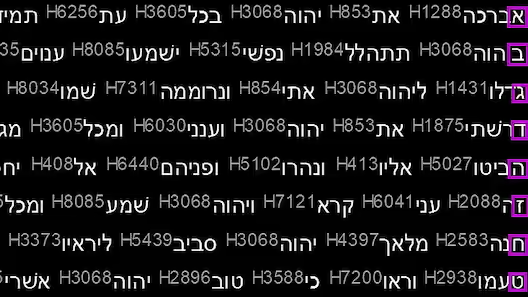
Examples of these patterns are the Hebrew acrostics in the Old Testament. There are some places in the Old Testament where each verse starts with the next letter of the Hebrew alphabet. These alphabetic patterns are thought to have aided in memorizing and copying the text.
The Bible Codes are similar to these acrostics. They can be thought of as "super-acrostics" that are revealed by computerized searches of the text. The researcher looks for certain words and phrases in the text, perhaps related to an historical event. When groups of related words and phrases are found together then this is understood as a "Bible Code".
How do you find a Bible Code?
To find a Bible Code, a researcher arranges the Hebrew Bible, typically the Torah, into a continuous block of letters. A computer then searches for specific words or phrases in various directions, skipping letters at regular intervals (e.g., every 2nd, 3rd, or 4th letter). When related terms are found clustered together, they are interpreted as intentional messages.
Do these computerized searches make sense?
If we think about it, there's an obvious problem with this methodology. If you're using a computer to rigorously search within a large block of text you're going to find a large number of words and phrases. This is true in any text, even random letters.
Furthermore, the number of words and phrases that can be connected with a particular event is also enormous. For example, I can easily make a list of twenty words related to the sinking of the Titanic. It would not be difficult to think of fifty words related to 9/11.
Then when I plug that list into a computer, and do an exhaustive search for the words, it should be no surprise that a lot of them are found. Some of them will even be found near each other. This is because there are so many combinations in that ocean of letters.
Are the codes in the Bible unique?
Using the Bible Code process we can find related words and phrases in any large text. But the codes that work well in one particular text will be different from another text. The codes that are found in the Bible are certainly unique, but the more important question is whether they are superior to codes that can be found in unrelated texts.
Bible Code researchers would, for example, search for many different historical events and select the ones that work well within the Bible. They would build up a collection of successful searches they've done using the Bible's text, that could not be replicated with other texts. This led to the claim that the Bible Codes "beat the odds".
Can the Bible Codes predict future events?
If the Bible Codes could reliably predict future events, then their validity would be undeniable. However, to find future events in the codes you have to already know what you're looking for. This is because there are so many different words and phrases that can be found in the ocean of letters. If you have to look for the codes after the event has happened, then this suggests you're creating the results rather than finding prophetic messages.
The Bible Codes had a certain mystique.
Some of the appeal of the Bible Codes was their convenience. They were a convenient shortcut from the long-term study of scripture. Instead of focusing on the testimony of scripture, like a pastor might do, the focus was on mundane proofs. Instead of the goal of revelation, the Bible Codes offered something more like divination.
The mystery of the Bible Codes enhanced their appeal. The process of uncovering codes through computerized searches was esoteric and hard to explain. Then the debate about their legitimacy would go down a rabbit hole of statistical analysis. In the end, people were swayed more by their preconceptions than any clear evidence.
Were the skeptics right about the Bible Codes?
Is it fair to dismiss the Bible Codes as a religious fad or gimmick? I certainly can't disprove every claim connected to the research. We also shouldn't forget that there are legitimate acrostics within the Hebrew text of the Bible. It's not unreasonable to look for complex acrostics in the text.

However, looking back it's clear that the Bible Codes were something of a fad. They had the right blend of mysticism, prophecy, current events, and techno-wizardry for mass appeal. Add in some interfaith virtue-signaling, and they took off. However, like many fads, they fizzled as people became frustrated with the lack of substance. There was a lot of hype, but the codes had no prophetic power.
The legacy of the Bible Codes is that they were an unnecessary detour in a more serious debate about the origins of the Bible. They were a kind of pseudo-apologetics that was sophisticated and exciting, but proved to be deceptive. They have become another false claim that has hurt the credibility of modern Evangelicalism.