Blood Speaks: The Prophetic Witness of Cain and Abel

Why does Cain murder Abel? The Bible tells us that God receives Abel's offering, but not Cain's offering. Because of this rejection, Cain becomes filled with jealousy and hatred towards his brother. Cain turns against Abel and eventually murders him, but is there a deeper prophetic pattern within their failed relationship? Was their tragic rivalry a prophecy of the future betrayal and sacrifice of Jesus Christ?
Why did God prefer Abel's offering over Cain's?
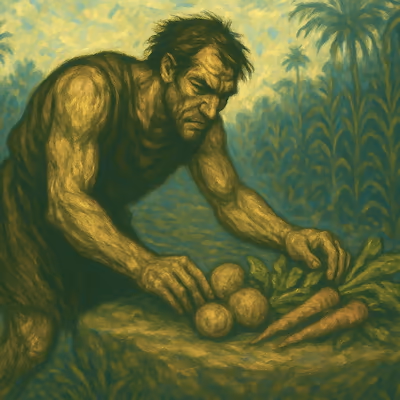
Abel's offering was a blood sacrifice from his flock, whereas Cain's was from the fruit of the ground. While this detail is important, it's not the underlying reason that God accepts one and not the other. God doesn't favor herding over farming, and he didn't love Abel because his occupation allowed him to give a blood offering.
Was Abel's offering worth more than Cain's? Perhaps Abel gave the best and fattest of his flock, but Cain gave stunted and bruised vegetables. Did Cain bring the rejects of his harvest to the altar?
There's nothing in the text that suggests a large disparity in the offerings. It says Cain brought of the fruit of the ground, and Abel brought from the first born of his flock (Genesis 4:4). While Abel's offering may have had some greater monetary value, it doesn't say that Cain offered worthless produce. Indeed, Cain's intention seems to have been to please God, and he expected the offering to be received.
The offerings were types of communion, not bribes.
God does not receive carnal satisfaction from the world. God doesn't consume offerings the way that a person eats or consumes food. It's not as though God is a connoisseur in search of the tastiest morsels he can get. God already owns everything in the world, and being the Creator, he is in no need of material things. We should not confuse God's desire for sacrifice with the pagan experience of hungry spirits, who receive sustenance from the living.
Under the law, God instructed the nation of Israel to give many kinds of offerings, both from their flocks and their fields. Of course they were expected to give their best. However, the satisfaction of the offerings was not in their carnal substance or monetary value. Rather, it was in the underlying spiritual relationship that God had with his nation.
The offerings of Israel became tainted by sinful hearts and hands, "Oh that there were one among you who would shut the doors, that you might not kindle fire on my altar in vain! I have no pleasure in you, says the LORD of hosts, and I will not accept an offering from your hand" (Malachi 1:10 ESV).
A sinful and unrepentant priesthood could not give a pleasing offering, “What to me is the multitude of your sacrifices? says the LORD; I have had enough of burnt offerings of rams and the fat of well-fed beasts; I do not delight in the blood of bulls, or of lambs, or of goats" (Isaiah 1:11 ESV).
Why was Cain's offering vulgar to God?
Cain insulted God by thinking that he could please him with material gifts. Everything belongs to God, and it's only by grace we have something to give. Cain did not understand grace, or his own sinful nature. His offering was self-justified, not the result of faith. He thought he could stand righteously before God by his own contribution, but was ignored.
Cain's offering was a simple bribe. It was an exchange meant to produce a result. He gave God something of value, and his expectation was that God would accept it. Thus, he couldn't see the difference between himself and Abel. They both gave something of value, and by right, they both deserved acknowledgment.

When God chose Abel, it became clear that the problem was deeper than the quality of the offerings. Cain had to look at the difference in his own soul compared to his brother's. The spiritual difference between them ignited Cain's hatred, "We should not be like Cain, who was of the evil one and murdered his brother. And why did he murder him? Because his own deeds were evil and his brother's righteous" (1 John 3:12 ESV).
Cain's failed relationship with God was prophetic.
This is where we start to see Cain as the prophetic type. He was the first born, a spiritual heir of the family, yet his relationship with God was superficial. He assumes he knows God, but he doesn't know the nature of God. His offering appeared outwardly righteous, but was full of hypocrisy and sin. It was tainted by his unrepentant heart.
Notice how Cain shows no remorse, but lies to God about Abel, "And the LORD said unto Cain, Where is Abel thy brother? And he said, I know not: Am I my brother's keeper? And he said, What hast thou done? the voice of thy brother's blood crieth unto me from the ground" (Genesis 4:9-10 KJV).
We come to realize that Cain didn't relate well with God. He was carnal and selfish in his thinking. The values of God, such as truth and mercy, did not appeal to Cain. God had warned him about the deceptive and compulsive nature of sin (Genesis 4:7), but he didn't take the counsel to heart. Ultimately, Cain's relationship with God failed because he was not a child of God. Rather, he was of the "Wicked One".
Cain was a prophetic type for the Pharisees and Sadducees.
It was the religious leaders, the Pharisees and the Sadducees, who led the opposition to Jesus. The gospels describe them as outwardly righteous, but full of sin and hypocrisy. They are described as liars and deceivers, motivated by the idols of power and wealth. Like Cain, they had no sincere relationship with God.
Like Cain, they made superficial offerings tainted by sin, "Woe unto you, scribes and Pharisees, hypocrites! for ye pay tithe of mint and anise and cummin, and have omitted the weightier matters of the law, judgment, mercy, and faith: these ought ye to have done, and not to leave the other undone" (Matthew 23:23 KJV).
Jesus did many righteous works, some even in their presence. As the evidence of Jesus' works became undeniable, their resentment grew. The light of Jesus, his anointing and righteous works, was exposing their own wretched state.
At the root of their hatred was not that Jesus did anything wrong, but jealousy. They couldn't bear the intense contrast of Jesus' miracles with their own hypocrisy. Jesus had become a rock of offense to them (1 Peter 2:8).
"Then saith he to the man, Stretch forth thine hand. And he stretched it forth; and it was restored whole, like as the other. Then the Pharisees went out, and held a council against him, how they might destroy him" (Matthew 12:13-14 KJV).
Like Cain, the Pharisees were spiritually dead to God. If they were God's children they would have glorified his Son, but instead they were driven to murder by jealousy and hatred. Their motive was clear, "But Pilate answered them, saying, Will ye that I release unto you the King of the Jews? For he knew that the chief priests had delivered him for envy" (Mark 15:9-10 KJV).
There would be enmity between the "seeds".
The enmity of Cain and Abel begins with an earlier prophecy. Before they were born, God had said to the Serpent, "and I will put enmity between thee and the woman, and between thy seed and her seed: he shall bruise thy head, and thou shalt bruise his heel" (Genesis 3:15 ASV).
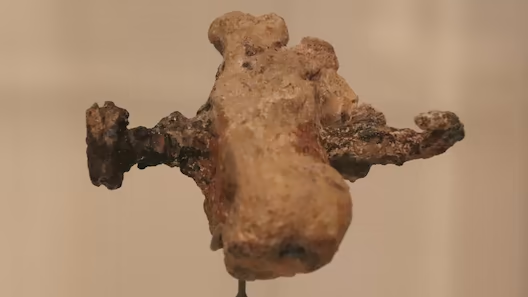
This cryptic verse would be fulfilled throughout the Old Testament. There would be a "seed" of the Devil that opposed the true seed of Israel. We see this enmity in the history of the nation; in types such as Jacob and Esau. Eventually, the seed of the Devil bruised the heel of Christ by nailing him to the cross.
Jesus confirms that the ones seeking to murder him are the Devil's seed, "Ye are of your father the devil, and the lusts of your father it is your will to do. He was a murderer from the beginning, and standeth not in the truth, because there is no truth in him..." (John 8:44 ASV).
Was Cain's punishment also prophetic?
Cain had lost his battle with sin, allowing it to prevail within his heart and mind. He spilled innocent blood on the ground, and so the ground would no longer give him its strength. The grace that he had as a farmer, to work the land and bring an offering, was gone. He would be an exile in the world, and whatever superficial relationship he had with God was dead (Genesis 4:14).

Cain does not show remorse or ask for forgiveness. Instead, he protests the severity of his punishment. He would have to wander in uncertainty and suspicion, afraid that someone would identify him. If they knew his past, they might avenge his crime. Who would trust a murderer like Cain, or want him in their community?
In response to Cain's fears, God says that seven-fold vengeance will be taken on one who slays him. God then puts a protective mark on Cain to warn those who might find him. This mysterious mark would be a sign to anyone who found him that they should not slay him in vengeance.
The obvious question is why would God want to protect a killer like Cain? There were no mitigations in his crime. He was a dangerous man who was motivated to kill by jealousy and hatred. Cain's life would have no purpose except to increase sin in the world, even leading up to the flood.
The mark of Cain was prophetic of Israel's exile.
The history of Israel is one of rebellion against God. They rejected the prophets, embraced sin, and suffered severe judgments. In the gospels, they were influenced by hypocrites, the Devil's seed, who crucified Christ. Sin prevailed over the heart of the nation as they excommunicated those who confessed Jesus (John 9:22). The nation went on to persecute the early church, and undermine the spread of the gospel.
Jesus' generation would be held guilty for the "blood of Abel", "from the blood of Abel unto the blood of Zachariah, who perished between the altar and the sanctuary: yea, I say unto you, it shall be required of this generation" (Luke 11:51 ASV).
In 70 AD, after Israel had rebelled against Rome, the Roman army destroyed Jerusalem and leveled the temple. Then after another rebellion that ended in 135 AD, the nation was completely defeated, and Jews were banned from Jerusalem. As a final blow, the Romans changed the name of the land from Judea to Syria-Palestina.
The remnant of Israel could no longer exist as a nation within the promised land. They would have to live in distant Gentile lands, often under fear and suspicion. They would become a wandering people, struggling with the past judgments and promises of God. God's plan was to punish Israel, but as with past judgments he would not make a full end.
When we see the obvious parallels between the exile of Cain and Israel, we can better understand why God marked Cain. He didn't mark him because he had a bleeding heart for a murderer. Rather, God marked him because Israel, in the prophetic sense, is protected. Thus, the mark of Cain looked forward to the preservation of Israel in the gentile world. The mark was a sign of survival for the fallen nation.

God is not done with Israel, "For I would not, brethren, have you ignorant of this mystery, lest ye be wise in your own conceits, that a hardening in part hath befallen Israel, until the fulness of the Gentiles be come in" (Romans 11:25 ASV).
Skeptics claim that the story of Cain and Abel is a myth. However, the evidence suggests the story has a much deeper design. Cain and Abel are a witness to the accuracy and fulfillment of biblical prophecy over thousands of years. The story is one of many in the Old Testament that confirms the identity and testimony of Jesus; the Son of God and Savior of the world.